
“Lumber”
“Did you get a lumber on Saturday? ” means getting fixed up with a romantic assignation. A click.
“Stoor”
“Pass me the cloth, there is a bit of stoor on this table.” Stoor means dust.
“Stramash”
A voluble argument, raised voices, arms waving – a bit of theatre as blood is up.
A stramash would probably be one stop short of a scuffle. In our view, scuffle is a rather wimpy word and the Scots “rammy” is far more expressive.
“Snell”
Although it has been pretty mild recently , with temperatures in Edinburgh and Boston being pretty much the same in the mid fifties Fahrenheit, the coming months will see the onset of some snell winds. In Scotland, a snell wind is one that has a bit of bite. It is probably less than completely freezing but sharp enough to make you grateful that you have some cosy outerwear.
One of the things about the meaning of Scottish words is that there is a certain fluidity. The meaning might vary a tad between areas and also might change from year to year.
If you have any thoughts about Scottish wurrds, please email us at voicesfromscotland@gmail.com
“Nyaff”
An insulting term referring to an annoying and inconsequential person. “He is just a wee nyaff.”
“Clarty”
Covered in mud, gunge or grime. Dirty, but sticky dirty. Covered in mud, gunge or grime. Dirty, but sticky dirty.
“Footering”
To footer about is to waste time in addressing a task.”He was never going to get the thing done properly. He spent all his time footerng about.”
In 1976 the Greenock Telegraph got stuck into a teachers’ union that it felt was falling down on the job “As an example of its characteristic footering, ineffectual, pussy-footing approach to negotiation….”
“Weans”
Weans, pronounced “wanes” is the Scots term for babies and infants. It comes from “wee ones.” The expression “Ma. Pa and the weans” is a handy description of a traditional family unit.
“Bairns”
A bairn is a young child. At what age does a child outgrow the term? There is no hard and fast rule but as a rule of thumb a bairn will be quite happy to hold a parent’s hand when crossing the road. By the time they feel that to be a bit babyish they will have progressed to being a kid or youngster or whatever.
The Falkirk Football team is know as The Bairns. That comes from the burgh’s ancient motto which claims that it would be easier to meddle with the devil than with the bairns of Falkirk.
“We are all Jock Tamson’s bairns ” is still a common expression in Scotland. It expresses the sentiment that we are all part of the human race and have a certain sense of community.
“Dreich”
A dreich day will be cool, grey and overcast. This word is used quite a lot in Scotland.
“Couthy”
Warm, positive/homely. “She was a couthy soul” might describe a sweet aunt.
In 1981 an English Sunday Post reader recounted asking the conductress if the bus went to Victoria station.. “Aye son, we tak you right on tae the platform and wave you ta-ta.” The lady was described as a cheery Glasgow girl with a smile for everyone who brought a lot of pleasure to her passengers.
A random social media quote: “My mum says that the sun aye shines on the righteous. I think the moon aye shines on the couthie.”
If you like to peruse some fun Scottish designed gifts, head over to www.outhie.co.uk. They have a shop in Dunbar and also do mail order.
“Teuchter”
Someone from the Highlands, probably from the north west. The word is now sometimes used for a pub or restaurant.
“Laldy”
“She really gave it laldy” means that the person went full throttle – flat out.
“A Hoolie”
Yesterday was distinctly breezy, as can happen in October. A pal said “It’s blowing a hoolie out there.”
Always a danger of a kilt malfunction. https://www.facebook.com/watch/?v=895323828654156
” Hurl”
To go for a short trip in a car. (“I like your new motor – let’s have a wee hurl.”)
“Blootered”
Drunk, but if the ball was blootered up the park that would convey a strong kick up a football pitc.
“On The Broo”
In receipt of unemployment benefit in Scotland. Perhaps it is an adaptation of “bureau.”
“Fash”
To get upset or overly concerned. “Dinna (don’t) fash yourself A bit more bite than “Don’t let it get to you.”
To get upset or overly concerned . “Dinnae fash yourself” has a bit more bite than “Don’t let it get to you.
“Perjink”
It means ‘just so’ or ‘perfect’ but with a slightly mocking overtone. Perhaps ‘Perfect but a tad overdone’ is fair.
If you had a friend round for a meal and the table was laid with the finest linen and the cutlery and crystal glasses were shinedt to perfection, the guests might feel a touch overawed by the perjink presentation.
Jenners, the principal Edinburgh department store in the 1990s was described as “douce and perjink” by Jack Maclean. ( Maclean described himself as “Scotland’s urban Voltaire” which was pushing things.)
“Stocious”
This is one of several Scottish words for drunk. Proper drunk, not just a a tad tipsy. It cannot be qualified. He could not be a little stocious or very stocious. If you are stocious you are out of the park, as we say here.
“Hirple”
It means to walk awkwardly, probably with a limp.
“Rubber” (verb)
” I got rubbered” means I got ignored or snubbed.
We got this form Paul Third’s excellent YouTube on “Understanding the Dundonian dialect” by Paul Third which is a great listen.
We will be coming back to more Dundonian specific words, but of course the audio adds so much and Paul’s pronunciation of “peh” for pie, is a great joy.
“Shoogly”
This one is used quite often in Scotland. If something is not fastened or aligned properly it will become loose in motion and move unevenly. A shoogly supermarket trolley comes to mind. “My bicycle wheel started shoogling, I was worried it was going to come off.”
But a common usage is “His jacket was hanging on a shoogly peg” usually meaning n that a person’s job was in jeopardy.
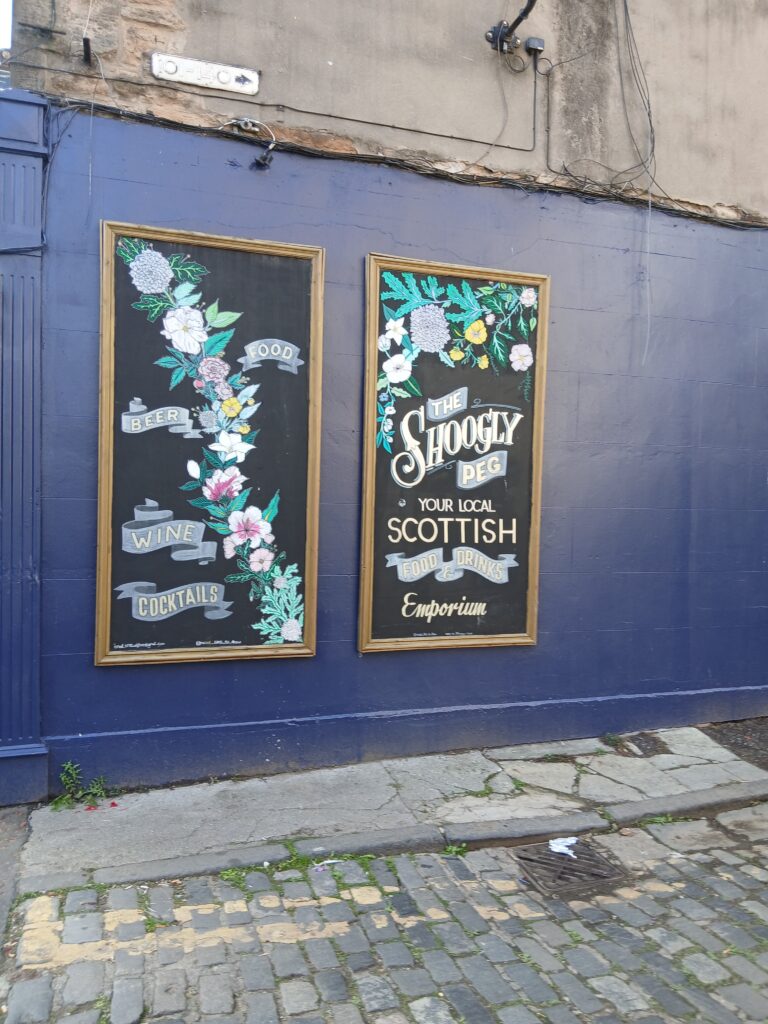
If you come to Edinburgh you can visit The Shoogly Peg – a pub, per the pic below
“Jings”
This charming wee word is an exclamation – think ‘wow’ or “golly gosh.”
It relates to a word used by a cartoon character, the impish Oor Wullie, a lovable scamp who rests on an upturned bucket in his trademark dungarees.
In 1999 a Scottish doctor provoked controversy by turning Oor Wullie into a murderous psychopath in his story entitled Wullie Unbound.
Dr Dorward took similar liberties with Wullie’s pals. Fat Bob lost his boyish charm when adulthood struck and he became an alcoholic and a double amputee.
Wee Eck , another of Wullie’s juvenile compadres came to a sticky end by being tied to a chair by his former friend and burnt alive. That got Wullie committed to an asylum for the insane.
Jings, that story was a shocker.
“Crabbit”
It means grumpy but it has a connotation with age. I cannot imagine a child being described as crabbit as it has an association with an older person who has fallen out of love with life.
Two Poems
“Crabbit Old Woman” Attributed to Phyllis McCormack
What do you see, nurse, what do you see?
What are you thinking, when you look at me
A crabbit old woman, not very wise,
Uncertain of habit, with far-away eyes,
Who dribbles her food and makes no reply
When you say in a loud voice, I do wish you’d try.
Who seems not to notice the things that you do
And forever is losing a stocking or shoe.
Who, unresisting or not; lets you do as you will
With bathing and feeding the long day is fill.
Is that what you’re thinking, Is that what you see?
Then open your eyes, nurse, you’re looking at me.
I’ll tell you who I am as I sit here so still!
As I rise at your bidding, as I eat at your will.
I’m a small child of 10 with a father and mother,
Brothers and sisters, who loved one anotherA young girl of 16 with wings on her feet,
Dreaming that soon now a lover she’ll meet,
A bride soon at 20 – my heart gives a leap,
Recalling the vows that I promised to keep.
At 25 now I have young of my own
Who need me to build a secure happy home;
A woman of 30, my young now grow fast,
Bound to each other with ties that should last;
At 40, my young sons have grown and are gone,
But my man is beside me to see I don’t mourn;
At 50 once more babies play around my knee,
Again we know children, my loved one and me.
Dark days are upon me, my husband is dead,
I look at the future, I shudder with dread,
For my young are all rearing young ones of their own.
And I think of the years and the love that I’ve known;
I’m an old woman now and nature is cruelTis her jest to make old age look like a fool.
The body is crumbled, grace and vigor depart,
There is now a stone where I once had a heart,
But inside this old carcass, a young girl still dwells,
And now and again my battered heart swells,
I remember the joy, I remember the pain,
And I’m loving and living life over again.
I think of the years all too few- gone too fast.
And accept the stark fact that nothing can lastSo open your eyes, nurse, open and see,
Not a crabbit old woman, look closerSee Me.
A Nurse’s reply “To the ‘Crabbit Old Woman”
What do we see, you ask, what do we see?
Yes, we are thinking when looking at thee!
We may seem to be hard when we hurry and fuss,
But there’s many of you, and too few of us.
We would like far more time to sit by you and talk,
To bath you and feed you and help you to walk.
To hear of your lives and the things you have done;
Your childhood, your husband, your daughter, your son.
But time is against us, there’s too much to do –
Patients too many, and nurses too few.
We grieve when we see you so sad and alone,
With nobody near you, no friends of your own.
We feel all your pain, and know of your fear
That nobody cares now your end is so near.
But nurses are people with feelings as well,
And when we’re together you’ll often hear tell
Of the dearest old Gran in the very end bed,
And the lovely old Dad, and the things that he said,
We speak with compassion and love, and feel sad
When we think of your lives and the joy that you’ve had,
When the time has arrived for you to depart,
You leave us behind with an ache in our heart.
When you sleep the long sleep, no more worry or care,
There are other old people, and we must be there.
So please understand if we hurry and fuss –
There are many of you,
And so few of us.